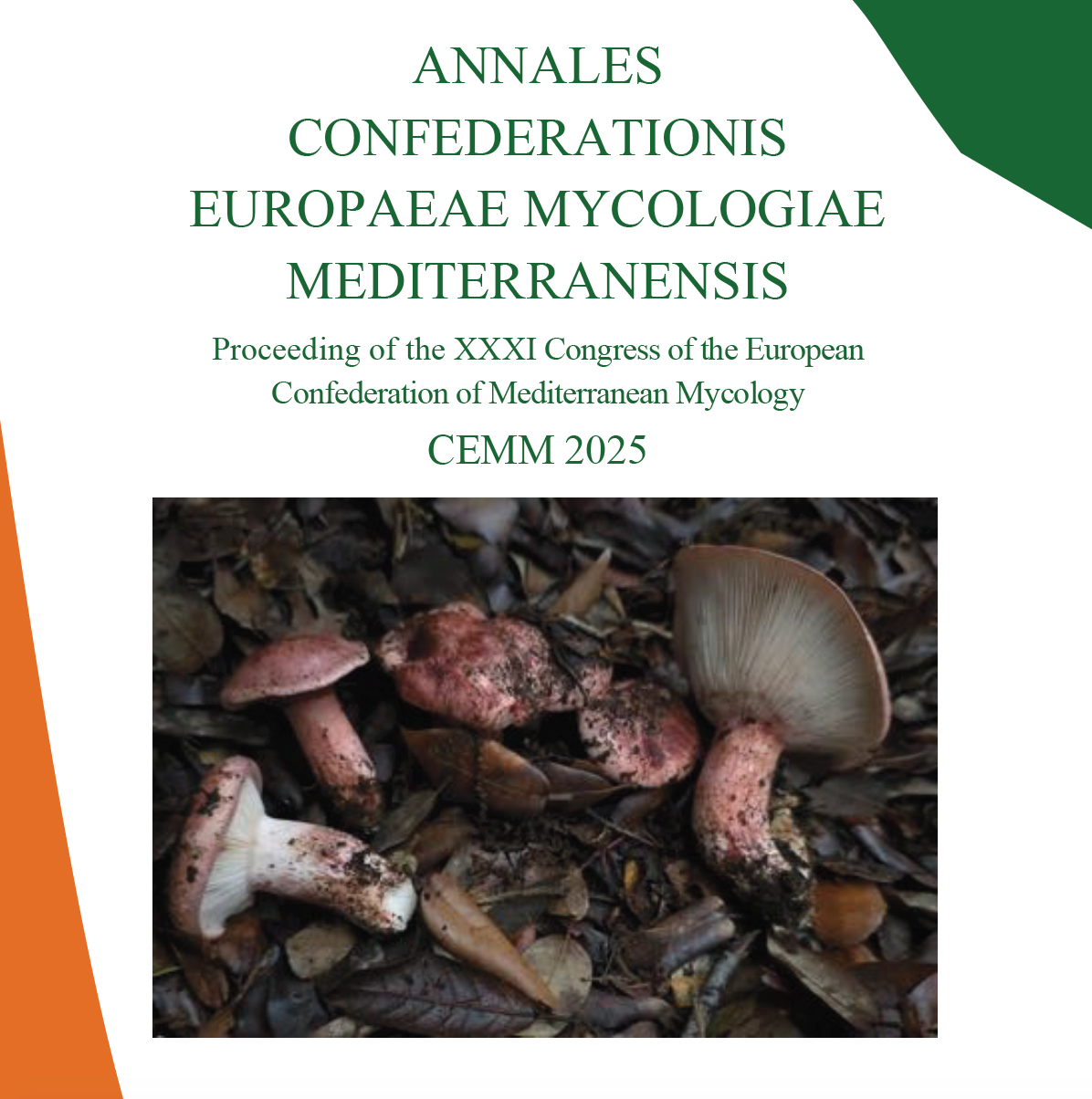
Proceeding of the XXXI Congress of the European
Confederation of Mediterranean Mycology
The 31st Congress of the Confederation of European Mediterranean Mycology (C.E.M.M.) was held in the municipality of Iglesias, Sardinia, Italy, from 24 to 30 November 2025. The event was organized by the Italian Mycological Union (UMI-APS), the “Paolo Fantini” Sardinian Truffle Hunters’ Association, the Bresadola Mycological Association (Gruppo di Cagliari), and the Municipality of Iglesias.
This edition served as an international scientific meeting and a forum for research, education, and the study of Sardinia’s fungal diversity. At the same time, the Congress provided an opportunity to showcase the rich cultural, historical, and environmental heritage of the territories involved in the event.
The Congress brought together mycologists belonging to the C.E.M.M.-affiliated mycological societies, researchers, and fungal enthusiasts from several European countries, including Belgium, Czech Republic, Estonia, Finland, France, Germany, Greece, Italy, Norway, and Spain as well as participants from non-European countries such as Guatemala and Australia. The scientific and field activities focused on the extraordinary fungal biodiversity of Sardinia, fostered by the island’s highly diversified forest ecosystems, varied soil conditions, and remarkable range of habitats.
Numerous mycological excursions were conducted throughout the Congress, resulting in the recording of 338 fungal species, all of which were documented in the PlutoF biodiversity platform. Among these were several species of particular scientific interest, including Agaricus luteomaculatus (F.H. Møller) F.H. Møller, Alessioporus ichnusanus (Alessio, Galli & Littini) Gelardi, Vizzini & Simonini, Calonarius vesterholtii (Frøslev & T.S. Jeppesen) Niskanen & Liimat., Entoloma bloxamii (Berk. & Broome) Sacc., Hygrocybe aurantiosplendens R. Haller Aar., Hygrophorus roseodiscoideus Bon & Chevassut, Rubroboletus rhodoxanthus (Krombh.) Kuan Zhao & Zhu L. Yang, Xerocomellus sarnarii Simonini, Vizzini & U. Eberh., Xerocomus moravicus (Václ. Vacek) Herink. At the conclusion of the Congress, the collected specimens were displayed in a mycological exhibition hosted by the “Giorgio Asproni” Mining Institute, which was open to both participants and the local community.
The scientific programme featured 8 scientific presentations and invited lectures, whose abstracts are included in these Proceedings. Together, they provide valuable insights into current research on fungal taxonomy, ecology, conservation, biodiversity, and applied mycology, reflecting the breadth and vitality of contemporary mycological studies.
Participants also had the opportunity to discover the unique character of Iglesias, located in south-western Sardinia. Formerly known as Villa di Chiesa, this medieval town owes much of its historical development to mining activities. Its remarkable cultural heritage includes the Cathedral of Santa Chiara, Salvaterra Castle, the medieval Pisan walls, and the Church and Cloister of San Francesco. Visitors were also able to explore the Museum of Mining Art and the Mineralogical Museum, both of which preserve and celebrate the town’s distinctive mining history and identity.
The organizers wish to express their sincere gratitude to all participants, speakers, volunteers, sponsors, and local
institutions whose commitment and collaboration contributed to the success of the 31st C.E.M.M. Congress. We hope that these Proceedings will serve as a lasting record of an inspiring week of scientific exchange, friendship, and discovery in one of the most fascinating regions of the Mediterranean.
The Organizing Committee
31st C.E.M.M. Congress, Iglesias 2025
Read or download the document here:
https://mycologyconfederation.com/wp-content/ANNALES_CEMM_2025.pdf
Editors:
Simone Graziosi
Ariadne Furtado
Andrea Rinaldi
Alessandra Zambonelli