CEMM
Confederatio Europaea Mycologiae Mediterraneensis
The European Mediterranean Mycological Confederation (CEMM) is an international network that brings together mycological federations, associations, and researchers dedicated to the study of fungi in the Mediterranean region.
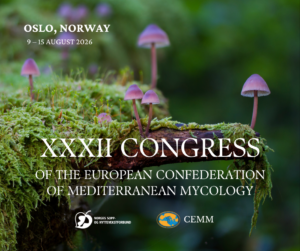
With more than 4,000 mycologists involved through its member organizations, CEMM supports research in areas such as taxonomy, ecology, mapping of species, mycotoxicology, and legislation related to fungi. One of its central activities is the organization of the annual European Mediterranean Mycology Congress, an international meeting where specialists gather to exchange knowledge, present research, and explore fungal diversity in different Mediterranean regions.
Through its scientific publications, meetings, and collaborative network, the CEMM plays an important role in advancing mycological research and fostering cooperation across Europe.
History
The C.E.M.M. (European Mediterranean Mycological Confederation) is a European organization founded on January 1, 1993, by three major mycological federations:
- A.M.B. (Associazione Micologica Bresadola) – Italy
- F.A.M.M. (Fédération des Associations Mycologiques Méditerranéennes) – France
- S.C.M. (Societat Catalana de Micologia) – Catalonia, Spain
- S.C.M. (Societat Catalana de Micologia) – Catalonia, Spain
- In 1994, the U.M.I. (Unione Micologica Italiana) – Italy joined the Confederation.
Over the years, the network expanded with new associated organizations:
- 2001 – The Grupo Micolóxico Galego (GMG), the mycological association “A Pantorra” (Portugal), and SOMICON (Cantabria, Spain) joined as associated members.
- 2002 – The Sociedad Micológica Valenciana (SOMIVAL) – Spain became part of the Confederation.
- 2010 – The Federación de Asociaciones Micológicas de Castilla y León (FAMCAL) joined as a federative member.
- 2010 – The NSNF (Norges Sopp- og Nyttevekstforbund) – Norway joined as an associated member.
In January 2006, the A.M.B. left the Confederation.
Today, the CEMM brings together more than 4,000 mycologists from different European countries who share a passion for the study of fungi.
Organization
The CEMM is composed of:

- A Board of Directors
- An Executive Committee
The Board of Directors meets twice a year:
- In spring, via videoconference
- In person during the European Mediterranean Mycology Congress, where the Confederation’s Annual General Assembly is also held.
Current Executive Committee
- President
Jean Paul Collin (FAMM) - First Vice-President
Alessandra Zambonelli (UMI) - Second Vice-President
Andrés Valverde Martínez (SCM) - Treasurer
Pilar Hoyo - Secretary
Annie Crosnier (FAMM)
Headquarters:
Muséum d’Histoire Naturelle
60 Boulevard Jean Risso
The Role of the CEMM
The CEMM focuses on mycological topics related to the Mediterranean region, including:
- Identification and knowledge of fungal species
- Mycological mapping and distribution studies
- Taxonomy and nomenclature
- Ecology
- Mycotoxicology
- Information technology applied to mycology
- Legislation related to fungi
The Confederation also organizes the annual international congress.
Publications
The CEMM supports the publication and dissemination of important scientific works, including:
- “Flore des Champignons Supérieurs du Maroc”
by G. Malençon & R. Bertault
Published in two volumes (1970 and 1975), reprinted in 2003
Price: €75 + shipping (for both volumes, not sold separately) - “Compléments à la Flore des Champignons Supérieurs du Maroc”
CEMM Edition, 2009
Price: €70 + shipping
In addition:
- Proceedings and annual reports from the CEMM meetings are also published following each event.
- Each federation or association affiliated with the CEMM publishes its own bulletin, usually available on their websites and
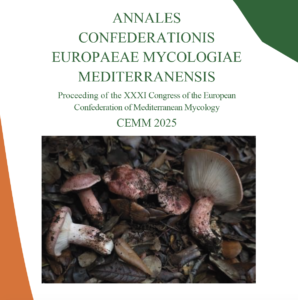
Annals of CEMM 2024 PDF (146 pages):
https://mycologyconfederation.com/wp-content/ANNALES_CEMM_2024.pdf
Edita: Sociedat Micolôgica Valenciana (SOMIVAL)
Diseño y maquetación: José Luis Egeda Hernánd
Annals of CEMM 2025 PDF ( 40 pages):
https://mycologyconfederation.com/wp-content/ANNALES_CEMM_2025.pdf
Editors: Simone Graziosi, Ariadne Furtado, Andrea Rinaldi, Alessandra Zambonelli